

鱼
P5286 [HNOI2019] Fish
Problem Description
Note: Source from Luogu.
The data for this problem says there are no issues
Problem Description
In a plane coordinate system, given distinct integer points (i.e., points with both x and y coordinates as integers), we define an ordered sextuple formed by selecting six distinct points from these points as a "fish" if and only if:
- , , (the body must be symmetric),
- , , , and are all acute angles (the head and tail cannot be concave),
- and are greater than (i.e., obtuse or straight angles, ensuring the tail does not appear awkwardly raised).
The following image is an example of a legal fish:
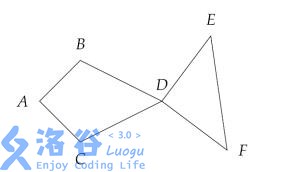
Fish with identical points but different sequences are considered distinct, meaning and are treated as two different fish (after all, fish have a back and a belly). Similarly, and can also be regarded as two different fish (assuming fish tails can be tied in knots).
How many fish can be formed from the given points? Specifically, the data ensures that the points are all distinct.
Input Format
The first line contains a positive integer , representing the number of points in the plane.
The next lines each contain two integers , representing the horizontal and vertical coordinates of the points.
## Output Format
Output one non-negative integer per line, representing the number of fish.
Input and Output Example #1
Input #1
eight
-2 0
-1 0
0 1
0 -1
1 0
2 0
3 1
3 -1
Output #1
sixteen
Instructions/Notes
For 62.5% of the data, it is guaranteed that: ; For the remaining data, ensure: ;
相关
在下列比赛中: